ABOUT US
We are exploring a new functional transparent glass material utilizing for sustainable society.
CURRENT RESEARCH
Synthesis and characterization of transparent photonics glasses without hazardous elements
Very small stress induced birefringent (photoelastic) oxide glasses for polarization-controlling optical materials
Structural analysis in functional oxide glasses
Lead-free zero/small photoelastic oxide glasses
We have continuously studied a photonics fiber which can utilize for an optical fiber typed current sensor. The important points of the device are hazardou element free such as lead, and are possessing a property of very photoelastic constant of consituent oxide glass.
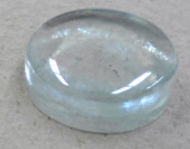
ZnO containing transparent SnO-P2O5 glasses
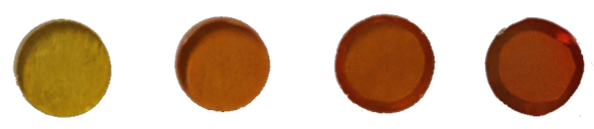
Binary SnO-SiO2 glasses
Fiber current sensors working in "smart grid" network
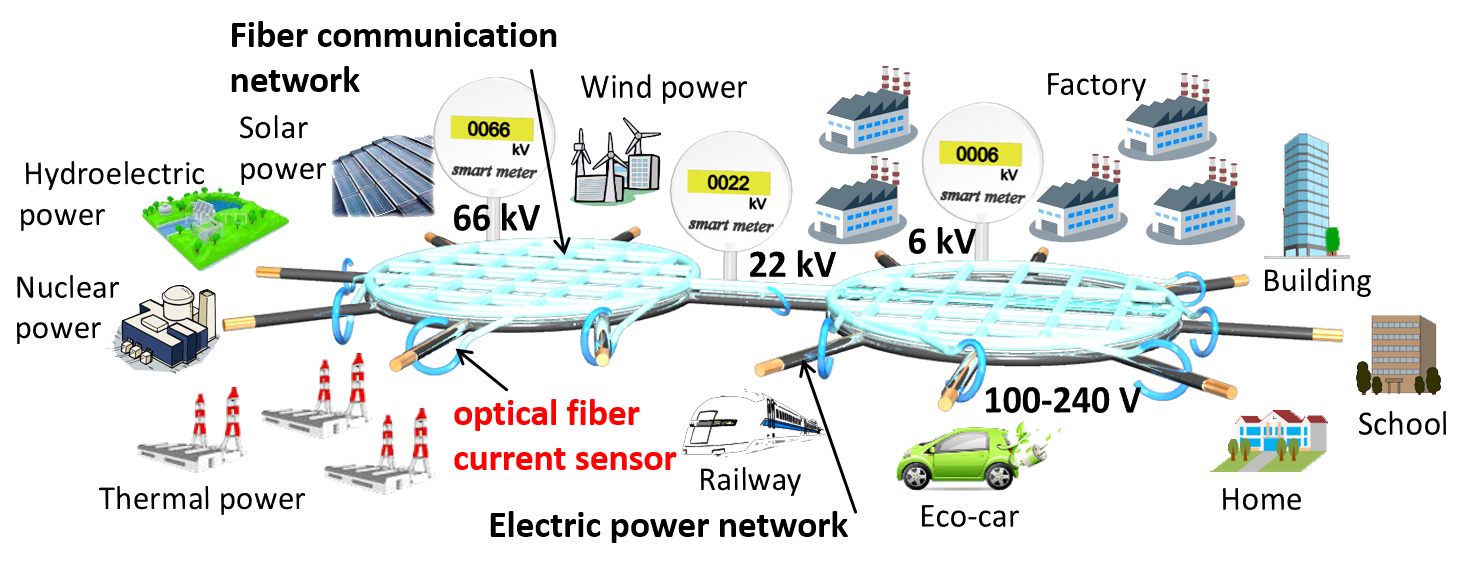
The ability of current sensing depends on the material- photoelastic property of the glass. Our glasses are categorized into lead-free oxide glasses which have very low photoelastic constant.
Faraday effect / photoelastic effect
Faraday effect
The priciple of current sensing is based on Faraday effect. The Faraday rotation angle of linearly polarized light corresponds to the magnetic field along the path followed by the fiber (Fig. 1).

Photoelastic effect
The signal is linearly correlated to the rotation angle but the sensitivity is drastically reduced by a stress induced birefringence, so called photoelastic effect, which occurs in the situation of the number of turns of fiber which is wounded around the conductor (Fig. 2).
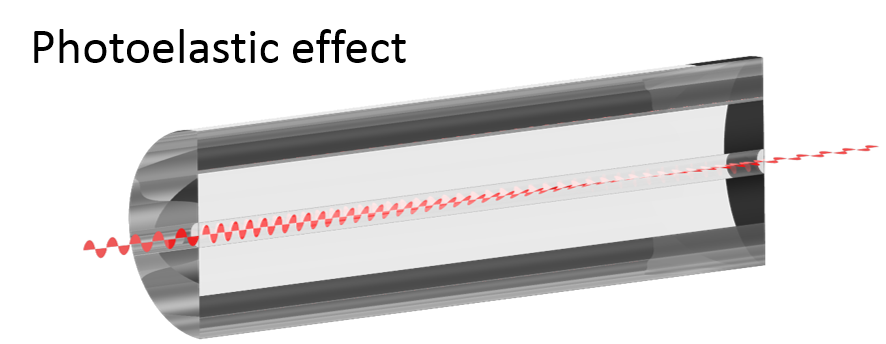
Zero photoelastic glass
Therefore, very small birefringent glass fiber having zero photoelastic constant (PEC) is desirable for maintaining its sensitivity to measure the current (Fig. 3).

SAITOH, Akira
E-mail & contact address
saito.akira.mg_at_ehime-u.ac.jpGraduate School of Science and Engineering, Ehime University, 3 Bunkyo-cho, Matsuyama, Ehime 790-8577, Japan, Professor

Graduate students advised
Undergraduate students advised
Education/Training
- Hokkaido University, Sapporo, Japan; B.A. (Honors); Applied Physics; 2000
- Hokkaido University, Sapporo, Japan; M.A.; Applied Physics; 2002
- Tokyo Institute of Technology, Tokyo, Japan; Ph.D.; Materials Science and Engineering; 2006
Positions & Employment
- 2006-2009; Postdoctoral Fellow, Applied Physics, Hokkaido University, Sapporo, Japan
- 2009-2011; Assistant Professor, Department of Electrical and Electronic Engineering, Kitami Institute of Technology, Kitami, Japan
- 2011-2016; Assistant Professor, Materials Science and Engineering, Ehime University, Matsuyama, Japan
- 2016-2019; Associate Professor, Materials Science and Engineering, Ehime University, Matsuyama, Japan
- 2017-2019; Specially Appointed Associate Professor (concurrent post), Institute of Innovative Research, Tokyo Institute of Technology, Yokohama, Japan
- 2019-present; Professor, Materials Science and Engineering, Ehime University, Matsuyama, Japan
- 2019-present; Specially Appointed Professor (concurrent post), Institute of Innovative Research, Tokyo Institute of Technology, Yokohama, Japan
Current Scientific Activities
- Developments for new transparent phosphate & silicate glass fibers using magneto-optics effect
- Basic study of optical & thermal properties in phosphate glasses
- Structural study in phosphate, boro-phosphate, borate, and silicate glasses
- Process developments in oxide-based slags and ceramics for recycling substances
University and Professional Service
- 2019- Member, Amorphous and Nano-Crystalline Materials and Applications, 147 th Committee, The Japan Society for Promotion of Science
- 2017- Program Review Committee, Glass, Micro-crystalline Program, The Japan Society of Applied Physics
- 2013-2018 Member, Amorphous and Nano-Crystalline Materials, 147 th Committee, The Japan Society for Promotion of Science
Visiting Appointments
- 2015-2016 Visiting Researcher: LASIR UMR-CNRS, Universite de Lille 1, Lille, France
- 2015 Visiting Researcher: Instituto de Ceramica y Vidrio, Madrid, Spain
- 2014 Visiting Scientist: Department of Materials Science and Engineering, Missouri University of Science and Technology, Rolla, Missouri, USA
Professional Societies
- The Japan Society of Applied Physics
- The Ceramic Society of Japan
- The Mining and Materials Processing Institute of Japan
- American Ceramic Society